


Heavy workloads, burnout, and benefit delays demand a new, consent-based approach
The federal government is increasingly holding states responsible for building and maintaining complex verification systems across public benefit programs such as Medicaid, SNAP (Supplemental Nutrition Assistance Program), and TANF (Temporary Assistance for Needy Families). This shift not only imposes enormous operational and financial burdens on state agencies, it creates challenges for the caseworkers administering these programs and the families in need of assistance.
While our previous analysis examined how states face potentially hundreds of millions in new costs as a result of legislative changes to income and employment verification guidelines, this post explores the hidden toll of those changes on caseworkers and, by extension, benefits applicants and recipients. It also considers how modernizing this process can bring relief to everyone involved.
What’s changed: the new verification landscape
For decades, federal law has required states administering public assistance programs to operate income and eligibility verification systems. But recent guidance and rules have added new pressure and expectations to the states’ verification responsibilities.
States now face stricter accuracy expectations. The One Big Beautiful Bill Act recently set penalties if states’ SNAP payment error rates go above 6%. With only five states currently below the 6% mark and penalties set to begin in October 2027, the pressure to improve verification accuracy is high.
New work requirements across benefit programs also add verification complexity:
- State administrators must now ensure able-bodied adults without dependents (ABAWDs) work, train, or volunteer for at least 80 hours per month to qualify for SNAP benefits. The age range for this eligibility requirement was extended to 64 (from 54), and exemptions for veterans, people experiencing homelessness, and youth aging out of foster care have been eliminated.
- Similarly, states must verify that Medicaid enrollees document at least 80 hours per month of community engagement, which may consist of work or other qualifying activities.
- To receive their full TANF block grant, states must also ensure that at least 50% of single-parent families and 90% of two-parent families receiving TANF benefits have adults engaged in 20-30 hours of weekly work-related activities
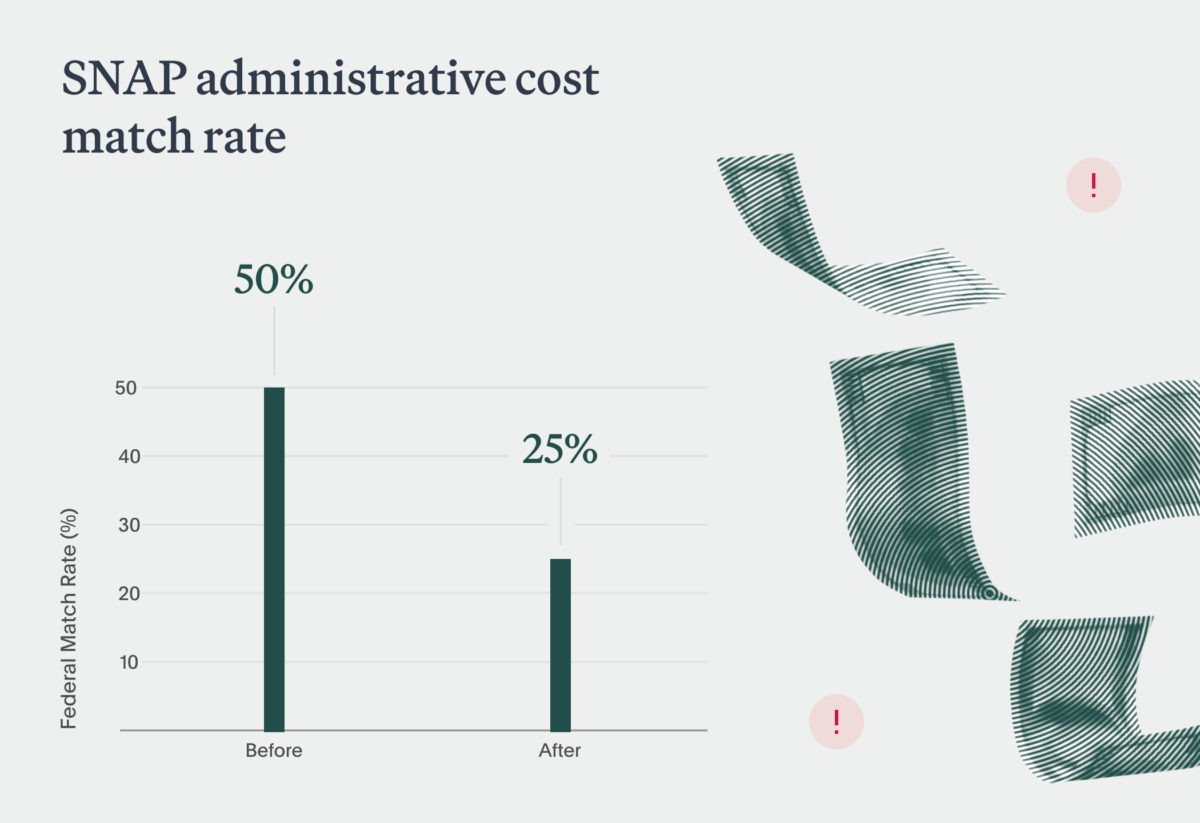
All of this arrives as the federal government cuts operational support. The match rate for SNAP administrative costs, for example, is dropping from 50% to 25%, meaning states have less funding for the staff, training, and technology needed to meet these new responsibilities.owing the match rate for SNAP administrative costs dropping from 50% to 25%
The caseworker crisis
At the same time, states face a workforce emergency: Up to 79% of social workers report burnout and over half are considering leaving their jobs. These alarming figures signal a crisis among workers charged with administering benefits programs.
And it’s not just a staffing inconvenience; it’s a problem with systemic consequences. According to CaseWorthy, roughly 70,000 social workers leave the field each year, primarily due to burnout or transfers to other industries. And the pipeline isn’t keeping pace: A 2024 survey of state mental health agencies found that 41 of 44 responding states reported a shortage of social workers. Nine of those states characterized their social worker shortage as “catastrophic,” meaning shortages so severe that they result in reduced available services or very long waits.
The new verification rules are likely to compound caseworkers’ burnout by adding to their administrative and emotional burdens.
Additional administrative and emotional burdens
Caseworkers are already drowning in verification tasks. They have to chase down documentation, contact employers, reconcile conflicting information across data sources, and enter data into multiple systems. When electronic records don’t match what applicants report, staff must make judgment calls about requesting additional documentation—decisions that carry real consequences for families waiting for benefits and state error rates.
But new accuracy pressures and work requirements will make their job even more stressful. Caseworkers will have to conduct granular, ongoing verification of applicants’ and recipients’ hours worked, and the sheer volume will be difficult to contend with. In Pennsylvania alone, the passage of The One Big Beautiful Bill Act increased the number of SNAP enrollees subject to granular work verification by almost 1,000%.
These verifications will be complicated by the fact that low-income adults are more likely to work in the gig economy, often across multiple gig platforms. Traditional verification approaches weren’t designed for this reality. State wage databases may not capture gig income at all, and third-party verification databases like The Work Number often lack visibility into shift-level hours. Without access to this data, caseworkers will be forced to manually conduct complex verifications for a significant portion of their cases.
As Dan Giacomi, director of program oversight and grants administration at Connecticut’s Department of Social Services, said in an interview with CNN, “You can’t just flip a switch in your eligibility system and have it do all of these new categories or new processes you have.” As a result, states like Connecticut have been forced to implement temporary workarounds that require caseworkers to manually input whether recipients meet new requirements.
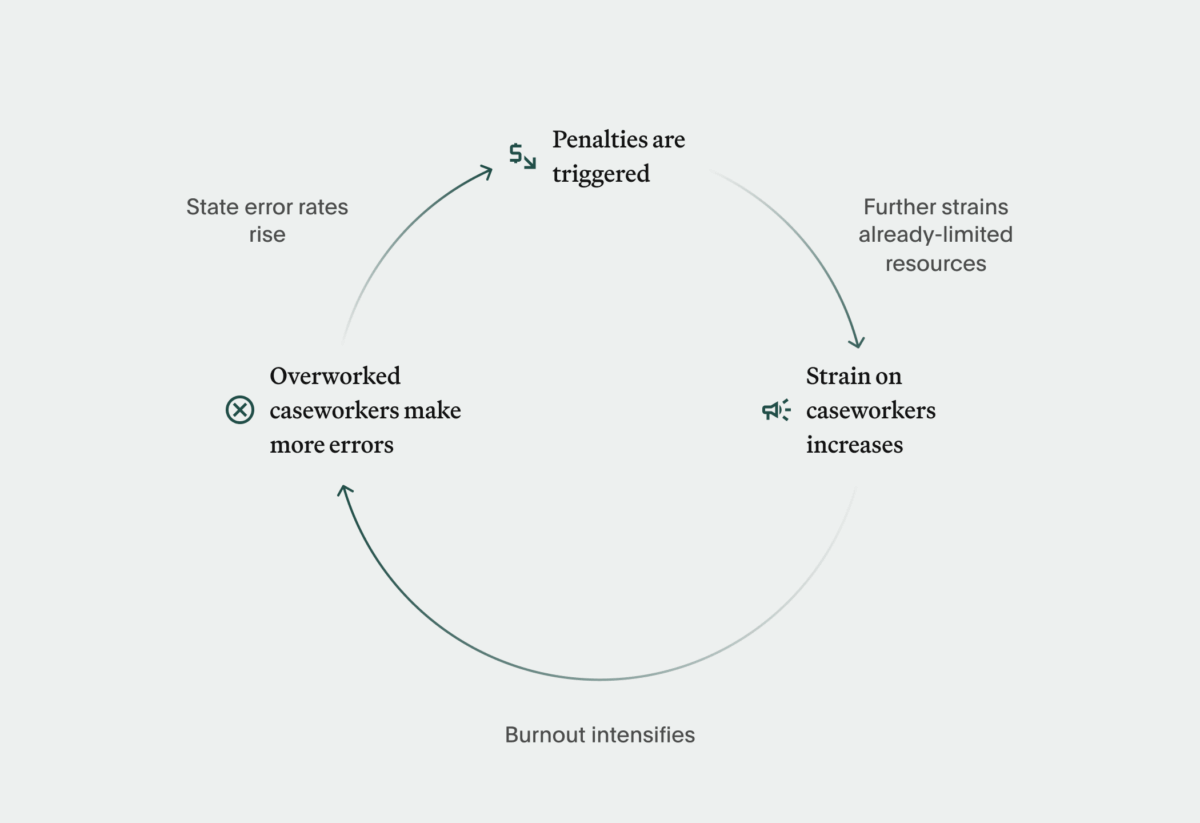
The result is a vicious cycle: Overworked caseworkers make more errors, which increases state error rates, which triggers penalties, which further strains already-limited resources, which puts further strain on caseworkers, exacerbating their burnout.
In addition to adding more to their plates, the new verification rules put caseworkers in a position of having to deny benefits to more applicants. According to the Congressional Budget Office, the expanded SNAP requirements alone will result in 2.4 million fewer Americans receiving food stamps in an average month over the next decade. For caseworkers who entered the field to help people, this can be an emotionally taxing new reality.
The applicant experience: delays that devastate
Meanwhile, for the 99 million Americans who rely on government benefits, verification errors and bottlenecks can lead to costly delays or loss of support. A recent survey found that about one in eight SNAP participants reported losing food stamps because of problems filing paperwork.
As Lauren Schulyer, assistant research director for family welfare research at the University of Maryland School of Social Work, explained via Newsweek, “Recipients who are unfamiliar with these new processes must navigate complex rules that are new to them, track and report work hours. These are learning costs. There are also compliance costs, such as gathering documentation, attending mandatory appointments, all of which require time, resources, and digital literacy.”
For benefit applicants and recipients without reliable transportation or unpredictable work schedules, these obstacles can prove insurmountable. And the consequences ripple through their lives. When they lose or are denied coverage, their grocery budgets evaporate, credit cards get maxed out, and they can’t access the healthcare they need.
The repercussions are serious. Research consistently links conditions like food insecurity to serious short- and long-term health and wellness issues. Children in food-insecure households experience more frequent infections, while adults face higher rates of chronic conditions like hypertension and diabetes. And studies have shown that when benefits don’t sustain families through the end of the month, the resulting gap in food access correlates with higher hospitalization rates and poorer school performance—just to name a few consequences.
Consent-based verifications: a solution for people, not just budgets
Fortunately, there are ways to mitigate the burdens of verification requirements. Automated, consent-based verification solutions, in particular, can transform the experience for everyone involved in the benefits determination process.
For caseworkers: reclaiming time for meaningful work
When verification data flows directly from payroll providers, gig platforms, and bank accounts in real time, caseworkers no longer need to chase documents, make phone calls, or manually reconcile conflicting information. That’s time they can redirect toward actually helping applicants and recipients—the work that drew them to public service in the first place.
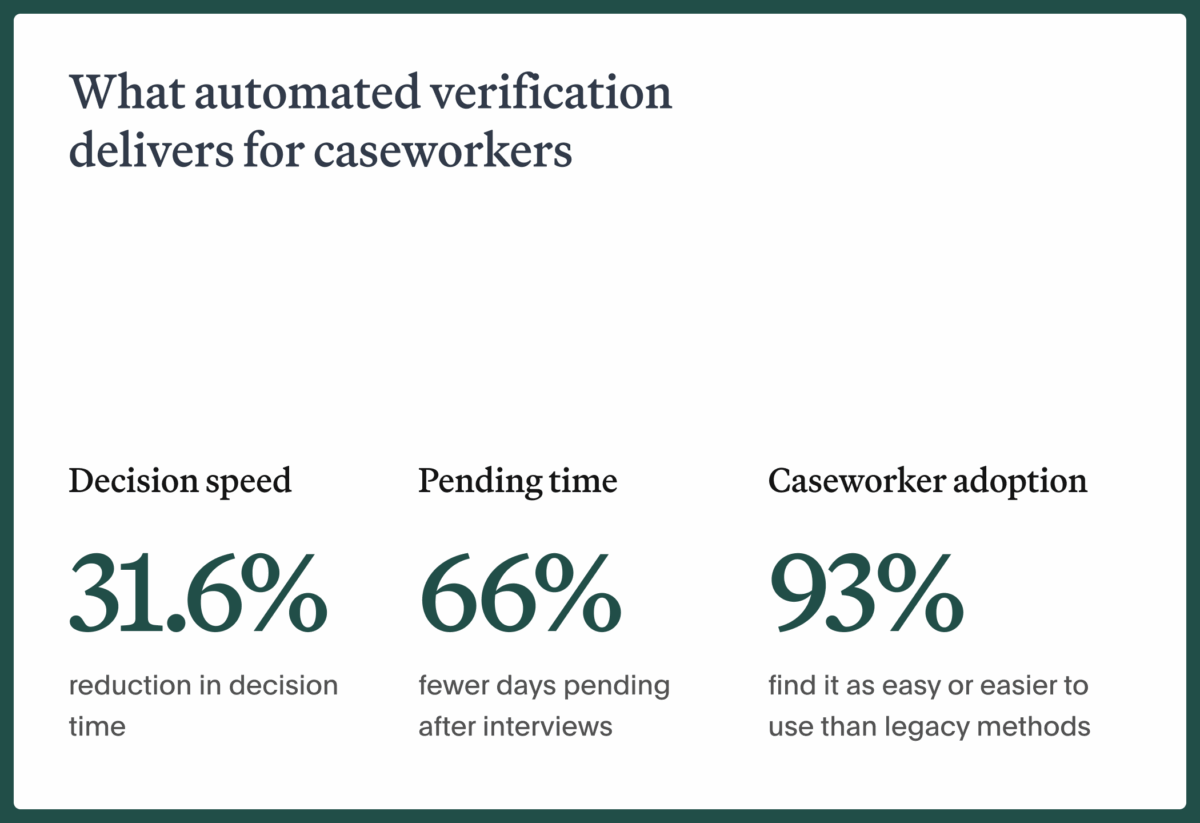
Consent-based verification solutions like Argyle have demonstrated measurable improvements in caseworker efficiency. States using automated verification have seen a 31.6% reduction in decision time and a 66% reduction in days pending post-interview. And when 93% of caseworkers find the solution easier or as easy to use as legacy methods, adoption becomes natural rather than burdensome.
For recipients and applicants: faster decisions, less stress
From the applicant perspective, consent-based verification eliminates most of the documentation burden. Instead of hunting down paystubs, downloading bank statements, and making trips to benefits offices, applicants simply connect their payroll, gig platform, or bank accounts through a secure interface. Data flows automatically, with 90% of verification reports containing income data from the last 14 days.
The process takes minutes rather than weeks. The median completion time is just 6.7 minutes, and 85% of applicants report no difficulty verifying their income. For families anxiously waiting to know whether they’ll receive help, this speed isn’t just convenient—it’s transformative.
For everyone: visibility into complex income
Last but not least, consent-based verification solutions capture the full picture of modern, non-traditional work. By connecting directly to gig platforms like Uber, DoorDash, Instacart, and dozens of others, these tools can pull shift-level data showing exactly how many hours someone worked in a given week or month.
This granular visibility is essential for complying with the new work requirements across programs. Rather than forcing gig workers to manually document their hours across multiple platforms, consent-based verifications aggregate this information automatically, reducing caseworkers’ workload, improving accuracy, and ensuring applicants get the benefits they qualify for.
Verification systems that serve people
Modern verification technology exists to dramatically reduce administrative burden while improving accuracy. The question isn’t whether states can afford to modernize—it’s whether they can afford not to.
When caseworkers have the tools they need to work efficiently, they stay longer and serve better. When applicants can verify their eligibility in minutes rather than weeks, they get the help they need when they need it. And when states maintain accurate records throughout the benefits lifecycle, everyone wins.
The verification responsibilities landing on states aren’t going away. But agencies that invest in solutions designed for how people actually work today will find that meeting these new requirements doesn’t have to come at such a high cost. The technology to verify income accurately, efficiently, and humanely already exists.
Ready to see how automated verification can reduce burden for caseworkers and applicants? Connect with Argyle’s government benefits team to learn how direct-source verification is transforming benefits eligibility determination across the country.